

 Table of Contents


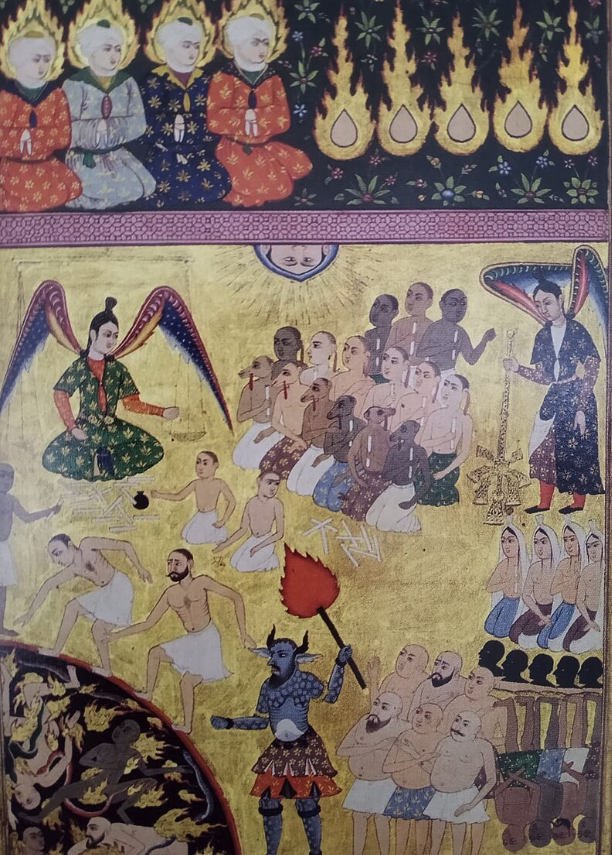
Painting depicting Day of Resurrection and the Bridge of Sirát. From Falnameh: India, 1610-1630.
For those with true comprehension, the passing of Siyyid Kázim marked the emergence of the first segment of this symbolic Bridge. The challenge ahead lay in navigating the myriad tests of ego and blindness, transcending earthly attachments and illusions to successfully traverse this initial stage. Only those who could withstand these trials with humility and insight would progress along the path towards the recognition of the Promised One.
How many of Siyyid Kázim’s disciples would make it across the first part of the Bridge? Which ones would survive?
67 madrasa [in Arabic] and madrisih [in Fársí] means “school” but meant religious school in the 1800s.
68There are different schools of interpretations of Shí’a Islamic law. The two major ones in Twelver Shí’a [Ithná-’Asharíyyih] in Írán were: Usulí and Akhbarí, with the usulí school being in the majority. These schools sometimes bitterly oppose each other. The Shaykhí school would be considered a minor school different from the two main ones.
69Mujtahid means someone who is learned in Islamic law. To become a mujtahid, one has to study Islamic law under other senior learned mujtahids [studies can take many years]. The person is eventually granted the status of a mujtahid allowing them to be an authority to practice Islamic law. A mujtahid can issue fatwas [authorized legal opinions]. They further can take on and train other students, preach in the mosques and head congregations.
70Details of Mullá Husayn’s background see Amanat Resurrection and Renewal Chapter 4, p156-159; Merabkhani Mullá Husayn – Disciple at Dawn Chapters 1-2’ p1-14.