

 Table of Contents


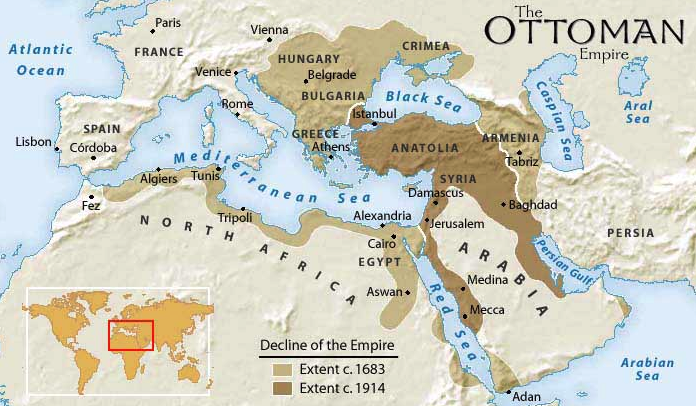
The Ottoman Empire: at its peak in 1600s [light brown shaded areas] and at its end in 1914 [dark brown shaded areas]. During the time of Siyyid Kázim, the Ottoman rule was in its last stages of decline [mostly the dark brown shaded areas].
Siyyid Kázim had established his base in Karbalá’, a city about 55 miles (about 86 kilometers) southwest of Baghdad. This region, although relatively close to Persia, was part of the Ottoman Empire. It had and still has a large Shí’a population because the area holds profound significance for the Shí’a due to its association with the revered Imáms.
After the death of Imám Hasan, Husayn became the 3rd Imám. A defining moment in Shí’a history is the martyrdom Imám Husayn together with his 72 companions in Karbalá’. Its importance to Shí’a ethos cannot be over-emphasized. After Imám Husayn, the line of Imáms continued. For the main sect of the Shí’a, this line of Imáms goes to the 12th Imám. Importantly, the Shí’a believe that the Imám’s are the divinely ordained successors of the Prophet. They [the Imáms] are the viceregents of God on earth and endowed with all perfections and spiritual gifts. Every believer must turn to them and follow them. For more details see Resources: Brief Background on Shí’a Islam.
39 The term ‘Atabát [means thresholds] is a shortening of ‘Atabāt-i-’alíyāt or ‘Atabāt-i-moqaddaseh [meaning lofty thresholds or holy thresholds] which the Shí’a use to refer to collection of four cities: Karbalá’, Najaf, Kázimayn and Sámarrá; all of which lie within a 100-mile radius of Baghdad. All four are extremely important for the Shí’a and sites of special visitations [zíyárat] for them. Karbalá’ is where Imám Husayn was martyred and is where he